Data movement is expensive.
Fetching and moving weights consumes energy and memory bandwidth. Faster arithmetic alone cannot remove that cost.
Native ternary AI acceleration
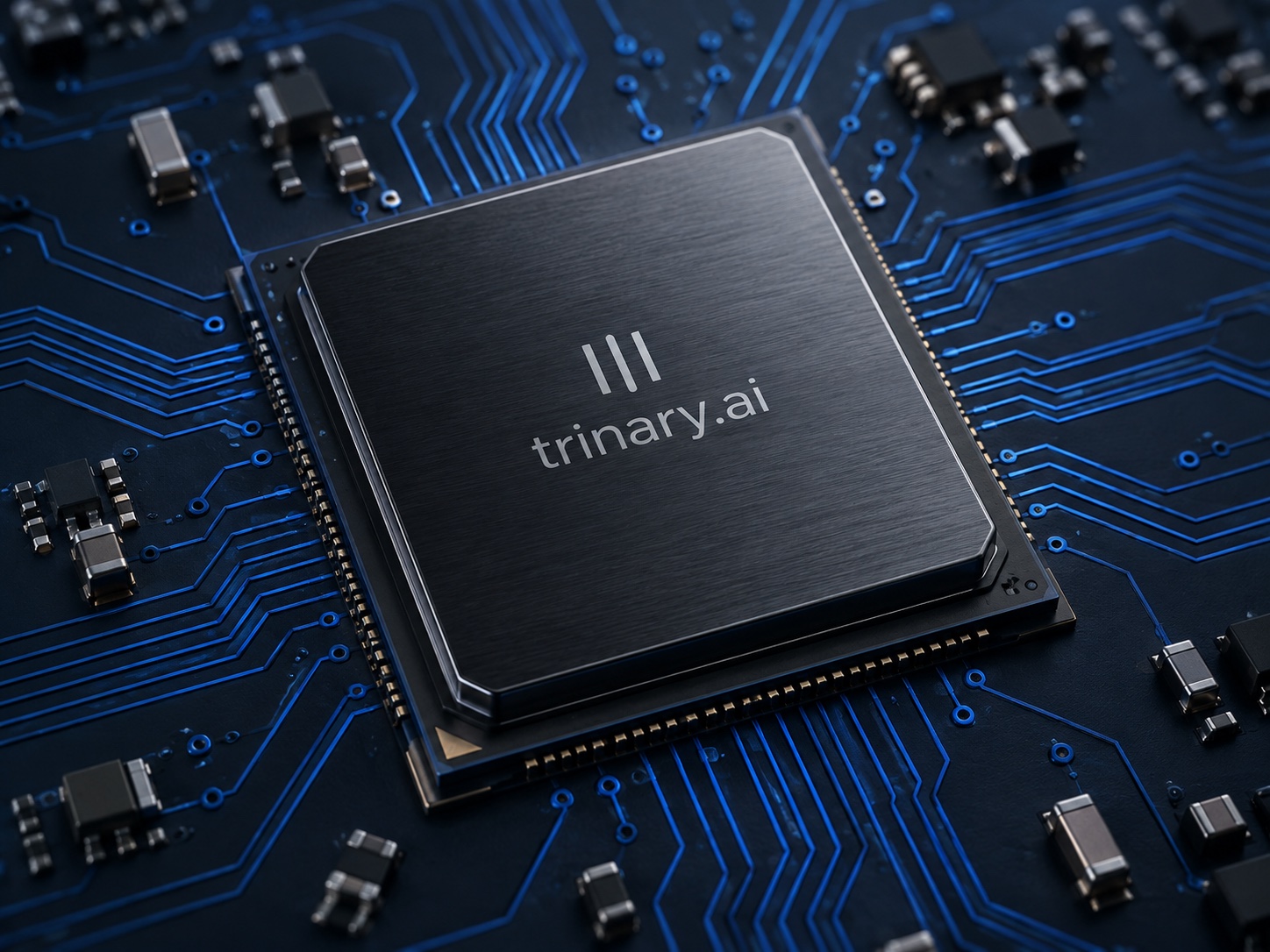
We’re developing an AI inference chip built around ternary intelligence—uniting memory and compute to make more AI possible within real-world power limits.
See our approachAustin, Texas · Memory + compute
Ternary models express their weights as −1, 0 and +1. Software such as bitnet.cpp runs those models using binary storage formats and conventional processors.
Our mission is to close that gap at the silicon level—and tackle the cost of storing, moving and using model weights.
Fetching and moving weights consumes energy and memory bandwidth. Faster arithmetic alone cannot remove that cost.
On conventional processors, ternary software packs weights into binary formats and uses specialized kernels to execute them. We’re targeting the next step: hardware designed around the same three-value model.
On-device AI shares a finite battery and thermal budget with the rest of the device. The challenge is to deliver more useful inference within those limits.
For a ternary weight, multiplying an input means taking its negative, making a zero contribution, or keeping it unchanged. That structure changes the work at the heart of inference.
Our focus is to build memory and compute around it, from how a weight is stored to how it is used.
Ternary software has opened a new direction for AI. Trinary.ai is taking that direction into native hardware.
Memory + compute + software
We’re developing a native ternary AI accelerator: an inference chip designed to store ternary weights and execute the operations that use them as one coordinated system.
The goal is straightforward: reduce the work required for inference, so more intelligence fits into the device’s power budget.
Develop a physical three-state foundation for ternary weights, aligning how the model represents information with how the chip stores it.
Design inference datapaths around ternary operations, concentrating hardware on the work the model actually needs.
Co-design memory, compute and software to reduce data movement and optimize energy per useful inference.
What we’re building toward
Our accelerator is in development; measured performance will be shared as hardware is validated.
We’re focused on AI that earns its place in the device: responsive, local and efficient enough for sustained use.
01 / On-device AI
Bring language, voice and contextual assistance closer to the user. Our target is responsive local inference that makes better use of limited memory and power.
02 / Battery-powered vision
Drones, smart glasses and battery-powered cameras need useful on-device vision—from navigation to scene understanding and event detection. We’re targeting lower inference energy and longer operation between charges.
The battery-life gain depends on inference’s share of total device power, alongside sensors, radios, displays and drone propulsion.
03 / Model serving
Scale efficient inference beyond the edge. We’re targeting the cost of storing, moving and processing model weights—the pressure points in serving larger models.
04 / Hardware and software
Develop memory, compute and model execution together. Evaluate complete workloads to turn device advances into useful inference performance.
The measure of progress: useful model accuracy, latency and energy per inference, tested against efficient implementations of the same workload.
Build with usA clear mission.
Deep engineering.
Trinary.ai is an Austin-based semiconductor company developing native ternary AI acceleration across memory and compute.
We believe the next generation of AI deserves hardware designed around the way it works. We’re building toward that future, from device physics to inference.

Founder · Austin, Texas
Vinny Lingham, Co-Founder and Chairman of Praxos Capital, is a recognized thought leader in crypto and digital identity who brings decades of experience as an entrepreneur, investor, and blockchain pioneer. He founded Civic and Gyft (acquired by First Data), was a General Partner at Multicoin Capital, and an early investor in leading projects such as Solana, Filecoin, and Render.
06 / Contact
For research, industry and company inquiries.